What a USDT Recovery Actually Looks Like
Constraints, episode 1

People hear “we recovered stolen Tether” and picture a heist in reverse. A key cracked, the thief’s wallet broken back into, the funds yanked out.
It is nothing like that. It is almost bureaucratic.
So what is USDT, really? Not just a coin sitting in a wallet. A smart contract. Think of it as a vending machine. Instead of taking your money and handing you a snack, it takes an instruction and moves a credit from one account to another. Your “balance” is just a number the machine keeps next to your address. When you send USDT, you are not shipping an object anywhere. You are asking the machine to subtract from one row and add to another.
That framing matters because a vending machine has an owner. Like any vending machine, it has an owner, and the owner can do things no customer ever could.
The USDT contract has special functions only Tether can call. Three of them tell the whole process of a recovery: blacklisting, burning, and minting.
A CRITICAL CAVEAT: not every token labeled “USDT” is actually issued by Tether. Common bridged versions of USDT (tokens that represent USDT on blockchains other than the native Tether-issued ones) cannot be frozen by Tether because they are not issued by Tether. They are separate tokens created and controlled by third-party bridge operators and backed by locked Tether-issued USDT as collateral. Although users often refer to them simply as “USDT,” they are technically distinct assets, and the freeze authority, if it exists, belongs to the bridge issuer, not to Tether.
Phase one: the freeze
The first thing that happens in a recovery is the freeze. When Tether blacklists an address, that address goes sticky. The number next to it is still there, you can still see the balance, but the machine will no longer accept any instruction to move it. The funds are stranded in place so the thief cannot run while the legal process plays out.
In practice, asset freezes are initiated early in the investigative cycle, often ahead of any final court ruling. Law enforcement agencies such as the FBI, DOJ, or their international counterparts secure the necessary legal authority under local procedures and coordinate with the stablecoin issuer. Speed is decisive: a delay of even a day can mean the difference between a successful freeze and an already emptied address.
If you want to verify a freeze, you don’t guess from the wallet balance. You check the contract state. When passing an address to the USDT contract’s isBlackListed view function, it simply returns a boolean. This simple true/false flag is the ultimate ground truth of the address state within the smart contract.
Phases two and three: burn, then refund
The freeze can sit for a long time. Weeks, months, or even years. And it does not always move at all. Many frozen addresses never proceed to a burn. They simply stay stuck. What comes next only happens when there is a legal basis for it and Tether decides to act.
Once the legal basis is established, the final two phases usually unfold within minutes of each other.
First comes the burn. Not a transfer. Not a seizure. A destruction, and the total supply shrinks by exactly that amount.
When funds are removed through the special burn function, some analytics platforms (Arkham among them) may not register the balance change from that transaction type, so an address that has actually been emptied can still display a full balance. For this specific step, cross-check on a block explorer (or USDTBanList) that reads the contract state directly, or you will think the money is still sitting there when it is already gone.
But if the stolen USDT has been destroyed, where does the victim’s replacement come from?
Not from the burned tokens, but from the treasury’s existing reserves.
The Tether treasury is pre-funded: USDT is minted in advance, independently of any single recovery, in enormous amounts, often billions of dollars at a time. That supply sits in the treasury waiting, with no connection to the case it will later settle.
On Tron, it is minted from a burn-style blackhole address and is then routed to the multisignature wallet; on Ethereum, it is issued directly into the treasury wallet from the Bitfinex multisig. See examples on Tokenview. However, this is a discretionary operational choice by Tether, and if you continue browsing through the pages you will find outliers.
And here is the detail that makes it provable: the payout is aggregate. Every frozen address involved in the case is burned, and one fresh lump, equal to all of them added together, leaves the treasury in a single move. This is where the recovery becomes visible on-chain.
The destroyed amount and the refunded amount match down to the last decimal.
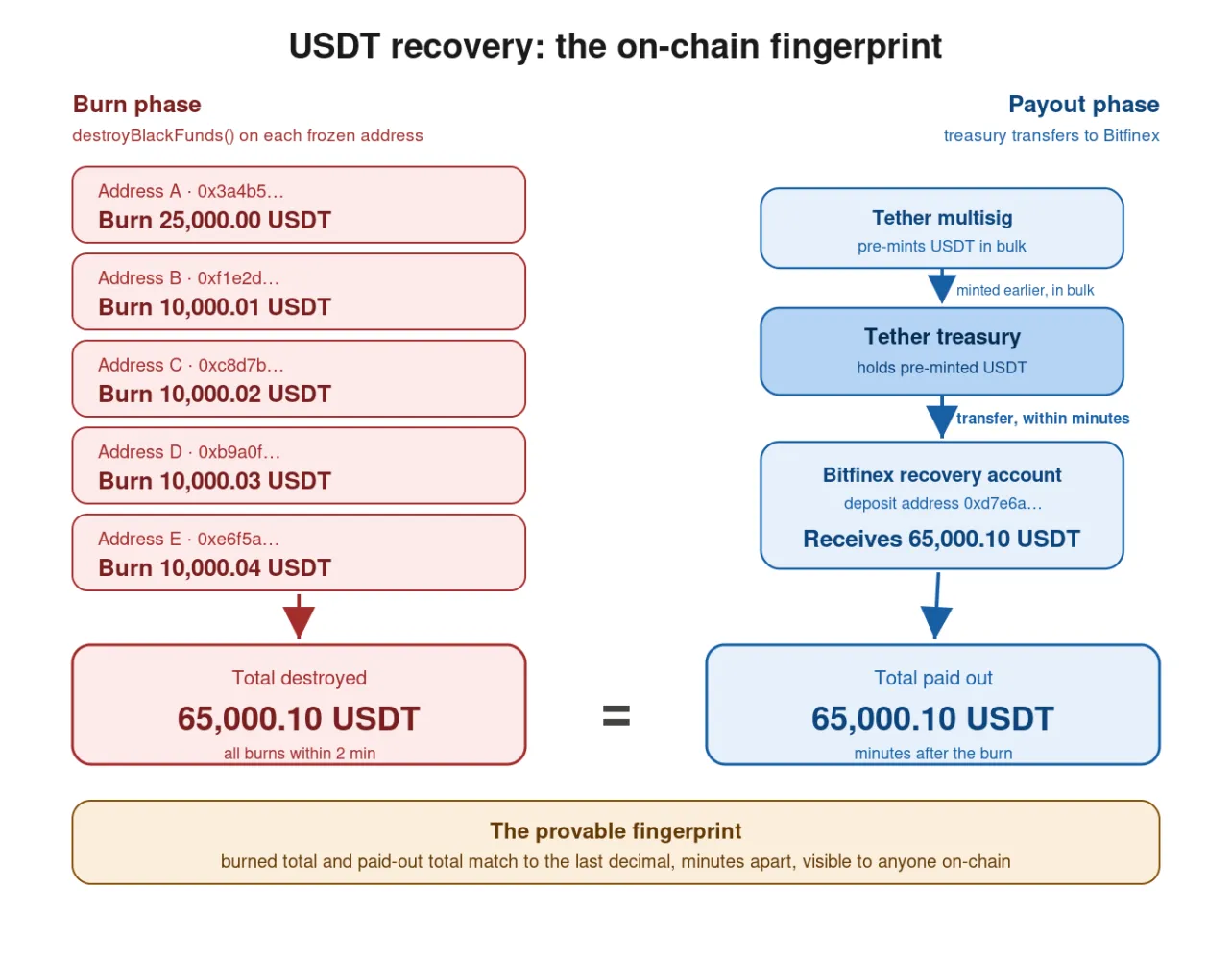
This decimal-perfect equality is the fingerprint, and it is visible to anyone willing to look on-chain. In the recovery cases I personally worked on, this was the smoking gun: multiple criminal addresses were burned within a two-minute window, and the exact aggregated total was paid out as a single lump sum just sixty seconds later from the Tether treasury address, although the refund is a separate transaction rather than an automatic consequence of the burn.
In these specific cases, the lump sum was forwarded to a Bitfinex deposit address, an exchange under the same iFinex corporate umbrella as Tether, re-entering the regulated market on its way back to the victim.
So, the thief’s tokens are never chased or seized. They are simply switched off, while an identical amount is released from a pre-existing reserve, and the math lines up perfectly.
The blockchain records every step.
A crypto recovery doesn’t look like a Hollywood heist. It looks like an accountant flipping two entries on a spreadsheet.
No cinematic exploits. Just absolute authority embedded directly into a smart contract.
Also published on LinkedIn.